
Expanded Results Supplement to
Landsman, R. E. 2005. RIP-ing away barriers to science
education: Inquiry through the research investigation process. In Exemplary science in grades 9–12:
Standards-based success stories, ed. R. E. Yager.
[The following data analyses and narrative provide evidence for RIP
Program impact on teachers and students and the achievement of the NSES More Emphasis Conditions necessary for
the achievement of the National Science Education Standards.]
The indicators for success of the RIP Program meeting more emphasis conditions at HLCS are comprised primarily of on-going evaluation in the form of formative assessments and student, teacher, and parent questionnaires, but also include evidence of exemplar student products up to the current point of implementation. The indicators for success at AAST include student products (publications, research talks) and their accolades, post-high school education opportunities, and follow-up student, teacher, and parent questionnaires to examine the long-term impact of the program on student participants.
HLCS-Nature of the Evidence
The impact of the RIP Program on science education at HLCS was evaluated
over the period Fall 2002 through 2003. Success
indicators include results from teacher and student pre- and post-RIP
implementation assessment comparisons; student, teacher, and parent questionnaire
responses; and “authentic” assessment of student performance and products in
the form of Ho`ike (“to show or “display”) presentation assessment/evaluation
by a diversified community audience composed of parents, students, teachers,
elders, community leaders, and scientists (Table 2).

(Table 2 continued)
Open and closed format items from the Teacher and Student Pre- and Post-Assessments, administered before
and after week-long RIP teacher professional development and student/teacher
RIP training sessions, respectively, were compared (Items 23-31 and 10-19, respectively). These items consisted of content knowledge,
perceptions, attitudes, and opinions related to science and learning about
science. The Post-Assessment contained
three additional items that students could not respond to until becoming
familiar with the RIP (Items 20-22). Closed
response formats included three-item multiple choice, four- or five-point/anchor
Likert Scales, or placement of a vertical line to indicate response on a horizontal
scale (0-9 or 12 cm) with four or five equally spaced anchors. A brief open and closed format Student Post-RIP Questionnaire to assess
the attitudes and opinions of students about learning science through the RIP
was designed and administered to peers by HLCS high school students mid-year,
2003 (n=30 students; closed format: four point/anchor Likert Scale; Items 1-3). Parent Questionnaires
were administered to twenty-four parents at the end of 2003 to assess their
opinions and perceptions of student learning at HLCS during the previous year
at HLCS (before the RIP was introduced to the school) compared to the present
time (one-year after the RIP was introduced to the school) [closed format: seven
point/anchor Likert Scale, Items 4-9]. An
open and closed format Teacher RIP Impact
Questionnaire assessed observations and opinions of positive impact of the
RIP on their students and themselves (n=5 teachers; closed format: five point/anchor
Likert Scale; Items 32-39). Authentic
evaluations of student work for subject matter mastery and understanding of
underlying concepts, creativity and organization, and teamwork and effort
conducted at the Fall 2002 and the Spring 2003 Hoi’ke were compared (Hoi’ke Assessment of Student Products,
closed format: four point/anchor Likert Scale; Items 40-42).
Student and teacher research paper publications and science and science education talks, and awards and recognitions contribute further evidence of the impact of the RIP Program on student success in learning science (Tables 3 and 4, respectively). Student products consisted of contributions to scientific knowledge through published and “in-press” papers, invited and other student research investigation presentations and science education talks (Table 3, Items 1-7, 10). The results of science fair and science symposium participation serves as further evidence of quality of products (Table 4). Teacher products consisted of contributions to the field of science education through science education talks (Table 3, Items 8-10).


Impact on HLCS Students and Teachers
Interest and attitudes in learning about science and learning in
general
The majority of students appeared to enjoy using the RIP and felt that it helped them to learn science (Table 2, Items 1 & 22, Table 5). Approximately four-fifths of the students claimed that they enjoyed learning through the RIP, with 35% saying they experienced much to very much enjoyment using this process, while two-thirds of the students said they enjoyed learning about science through the RIP. Student interest in learning through RIP-based scientific inquiry was exemplified by their continuing their research investigations well into the evenings on many occasions and during holidays and vacations. Student comments reflected a positive attitude regarding the use of the RIP (Table 5). Teachers felt that the RIP greatly helped them understand and respond to individual students’ interests, strengths, experiences, and needs (Table 2, Item 33). All teachers agreed that student engagement in the RIP stimulated student interest to learn science to a great or extremely-great extent and were engrossed in and took ownership of their learning (Table 2, Item 32; Table 5). Teachers felt that engaging students in inquiry-based learning using the RIP had a very strong positive impact on changing students’ attitudes towards learning science and learning in general (Table 2, Item 36; Table 5). Parents claimed that students have shown more interest in attending school and more interest towards academics at school since the RIP Program was implemented (Table 2, Items 5 & 7).
Table 5. HLCS student and teacher
comments regarding the influence of the RIP on student interest to learn
science
|
Student Comments |
|
“The RIP Process is an
excellent way to learn.” |
|
“It makes learning science
easier and less confusing.” |
|
“The RIP is a much better
way of learning compared to how we learned before.” |
|
Teacher Comments |
|
“Students started taking
interest in studying and also began answering questions more frequently. When learning about science, students were
so engrossed in what they were doing that they did not look at the wall clock
anymore and would exclaim at the end of the day that they could not believe
it was time to go home already. The
average grade level of the entire class was raised in one semester and
students were more interested in learning than ever before.” |
|
“Instruction through the RIP
gave students more ownership over their own learning experience.” |
|
“The material covered had greater
relevance and was more interesting to the students than that from traditional
coverage of curriculum or simple hands-on approaches.” |
The RIP also impacted teacher attitudes towards learning science with their students. For example, one exemplar teacher stated, “It was very exciting and intellectually more satisfying learning science through the RIP with my students than by memorizing textbooks and doing labs that already have a known outcome.”
Opportunities for
scientific discussion and debate among students
HLCS teachers reported that the RIP greatly enhanced their ability to provide students with opportunities to discuss and debate scientific information and issues (Table 2, Item 34; Table 6).
Table 6. HLCS teacher comments
regarding the RIP providing opportunities for scientific discussion and debate
among students
|
Teacher Comments |
|
“The structure of the entire
day changed so that there were large blocks of time available for extended
discussion on topics of interest, without the feeling that we will not have
time to cover all the material. Daily
seminars were held for student’s to present background material relevant to
their research investigations to each other.” |
|
“High school students
presented their research investigations to their peers, middle school
students, teachers, parents, community
members and professional scientists.” |
|
“Most of the topics that
were discussed in the class were always started from a relatively simple
concept about everyday life. The
discussion was guided by the teacher and/or the students toward a more
complex topic without the student’s overt recognition that this was
happening. This helped students remove
the mental block against learning ‘difficult’ scientific information. I could feel their happiness and sense of
achievement.” |
Communication skills
Both HLCS teachers and parents felt that the RIP and RIP Program promoted development of skills and confidence to enable students to communicate effectively through speaking and writing (Table 2, Items 4 and 35). These perceptions were corroborated by external sources. Following a HLCS student research talk at a Hawaii Department of Education Inquiry Professional Development Workshop, one teacher participant commented that the student presenters did an excellent job conveying complex scientific concepts and information to a “scientifically-unsophisticated” audience of teachers. Moderator and Executive Director of Native Science Connections Dr. Mark Sorenson, after hearing two HLCS student research talks at the 2002 Conference, exclaimed to the audience, “I don’t believe that I was exposed to a scientific talk of this caliber until graduate school!”
PHOTOGRAPH:
STUDENTS PRESENTING THEIR WORK AT A SCIENCE EDUCATION CONFERENCE
Critical thinking and
decision-making ability
Teachers reported that they felt that the RIP substantially impacted student ability to make good decisions and had a strong impact on the development of their students’ critical thinking ability (Table 2, Items 37 & 39, respectively). They also claimed that the RIP had a great positive impact on student abilities to critically evaluate data and so-called “facts” (Table 2, Item 39).
Facilitation of
teacher learning and instruction about science through inquiry
Teacher knowledge and understanding of the scientific inquiry process including data organization, analysis, and application of mathematics and probability theory to decision making in science significantly increased by the end of the RIP training and conducting of a teacher research investigation (Table 2, Items 23, 28 & 29). Teacher respondents claimed that the RIP professional development sessions and actually engaging in a RIP inquiry facilitated their learning of science through inquiry (Table 2, Item 31; Table 7).
Table 7. HLCS teachers’ comments, following training
and conducting a RIP-based study, on facilitation of their learning and
instruction about science through inquiry
|
“For me, the RIP removes the
intimidation of learning science, particularly the types of science with
which I have the most difficulty (physical science and chemistry). It breaks scientific inquiry down into
understandable steps.” |
|
“It showed me that it was
very exciting and intellectually more satisfying learning science through the
RIP than by memorizing textbooks and doing labs that already have a known
outcome.” |
Cooperation, shared
responsibility, and respect for supporting a classroom community
According to HLCS teachers, successful learning of science through the RIP necessitated and fostered cooperation and shared responsibility, including accountability for learning, and respect for the classroom community (Table 8).
Table 8. HLCS teacher comments regarding cooperation,
shared responsibility, and respect for supporting a classroom community
|
“With the RIP approach,
students often work in groups and assume responsibilities usually chosen
based on their strengths. Doing what
they are best at helped them acquire more confidence, but also made them assume
more responsibility and accountability to the welfare of their group because
they were working from their strengths.
It also helped to create a community because they could learn the
information relating to other aspects of the investigation from other members
of their research team.” |
|
“Because the RIP has an
ethics component, students learn to respect their similarities and
differences. They begin to share
knowledge more and work as a team so that they all may gain from the
experience. They also learn the
ramifications of misbehavior, including cheating in science and the impacts
that unethical behavior has on the individual and on society as a
whole.” |
|
“The RIP encourages
cooperation and shared responsibility, especially in a group project because all
members of the group are needed to develop, implement, analyze, and make
conclusions based on the study. The
group pools ideas, discusses how to solve problems that arise, and is often
needed when the study is being run.
Many studies require multiple students carrying out tasks
simultaneously. Each student must be responsible for their assigned task and
must work cooperatively with the others to accomplish the study. Student investigators from one study would
help other groups of researchers to meet deadlines or by training them in
something that the former had already learned.” |
Parents reported that students showed more to much more improvement in
their sense of responsibility towards finishing assignments compared to before
the RIP program was implemented at HLCS (Table 2, Item 6). Overall, Parents also felt that since the RIP
Program was implemented into HLCS, their children showed improvement in
handling responsibilities at home (Table 2, Item 8). Team evaluators rated HLCS student Hoi’ke presenters
significantly higher in demonstrated shared responsibility related to uniform
effort and contribution across individual team members and in team
communication ability following six months of learning through the RIP compared
with immediately prior to formally introducing the RIP into the school (Table 2,
Item 42).
PHOTOGRAPH: STUDENTS WORKING TOGETHER IN THE RIP
Impact of the RIP on student learning of science content, including
scientific inquiry
HLCS students substantially increased their knowledge and understanding
of the scientific inquiry process, including the different components and how
they are connected since the RIP was implemented (Table 2, Item 10). This was accompanied by significant increases
in self-reported understanding of inquiry-based concepts and increased
confidence levels related to understanding of and proficiency in using
scientific inquiry to learn science after learning the RIP (Table 2, Items
11-14). Student understanding and
ability to apply mathematical concepts to their decision-making almost doubled
by the end of their training in and implementation of a RIP (Table 2, Items 15
& 16). These increases in
demonstrated knowledge and ability were accompanied by significant increases in
student’ self-reported familiarity and understanding of concepts related to
data presentation, analysis, and the use of statistics in making decisions in
science (Table 2, Items 17 &18). Students
exhibited a significant increase in confidence in their ability to learn
science following RIP training, with three-fourths of the students reporting
that they learned more science through the RIP-based inquiry than they had
learned previously through traditional lab investigations (Table 2, Items 19 &
20, respectively). The majority of
students predicted that the RIP would help them as a general learning tool to
learn more in school (Table 2, Item 21).
Students reported that they learned more in the one year period since
implementation of the RIP Program compared with the prior year at HLCS and that
the RIP was helping them to learn in general (Table 2, Items 2 & 3). Parents of HLCS students stated that they
felt that their children were learning more academically compared to the year
and one-half at HLCS prior to implementation of the RIP program (Table 2, Item
9). Hoi`ke team evaluators rated HLCS students significantly
higher in demonstrated proficiency in understanding and being able to explain
to others scientific content, including scientific concepts and the inquiry
process they used to investigate the concepts, following six months of learning
through the RIP compared with immediately prior to the RIP being formally
introduced into the school (Table 2, Item 40).
Evidence of
Creativity
The RIP Program at HLCS serves as an ideal medium for fostering student
creativity consistent with the school’s vision of merging Hawaiian culture with
Western-standards-based science education.
The student products presented in the next section exemplify the
students’ creative use of the RIP to successfully meet this goal. Hoi`ke team evaluators rated HLCS students significantly higher in demonstrated creativity
in their use of inquiry to learn scientific concepts following six months of
learning through the RIP compared with immediately prior to formally
introducing the RIP into the school (Table 2, Item 41). The RIP stimulates students to be creative in
their presentation of their research investigations as well as in the designing
of the RIP study. One student, for
example, developed an i-movie of her entire RIP-based inquiry on a CD for
presentation at a science education conference.
This product was subsequently honored in a movie contest (Table 4, Item
4 ).
Student and teacher
products contributing to science and science education
Many of the more measurable RIP products
were in the form of student publications, teacher and joint teacher-student research
talks, and poster presentations. One
student paper was published in and a second submitted to a secondary/college refereed
on-line scientific journal (Table 3, Items 1 & 2). The former comprised the first controlled
scientific study to demonstrate direct effects of kava on heart rate and the
latter was the first study to scientifically investigate a physiological impact
of the Hawaiian Breath of Life on
humans and compare its relaxation effects with those resulting from
diaphragmatic breathing. Five invited student research talks were
delivered (Table 3, Items 3-7). For
example, as a result of successful student research presentations by HLCS
students at a Native Science Connections Conference in science education in
AAST-Nature of the
Evidence
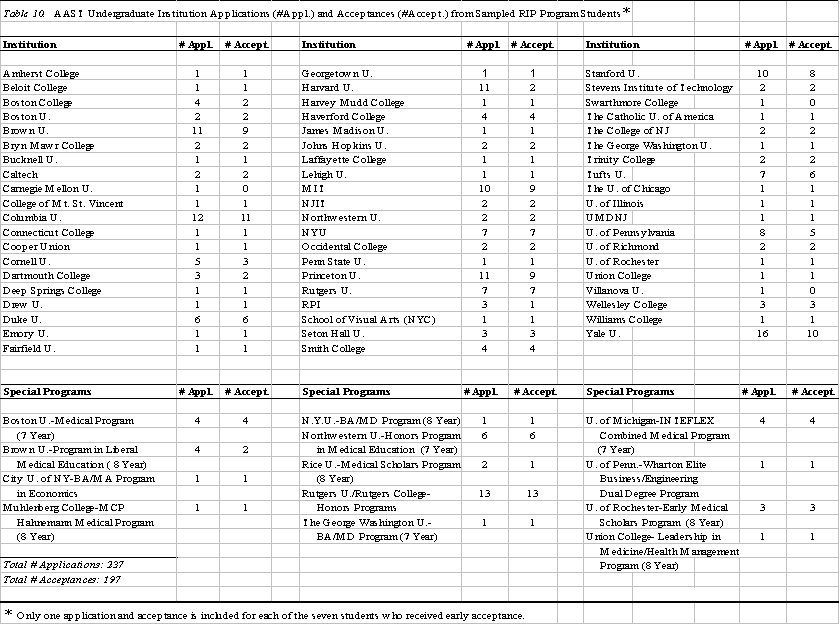
The RIP Program impact on students and teachers was measured using a variety of assessment and evaluation tools, and indicators collected from 1994 to the present. Tables 9 and 10 present data from student, teacher, and parent questionnaire items and RIP student college and university applications and acceptances, respectively.



(Table 9 continued)
The students included in this evaluation of the RIP Program
were 24 males and 16 females from the 1996-2000 graduating classes. Forty-five of the 75 students that were
involved in the RIP Program during 1993-1999 were randomly selected and
attempted contact was made via E-mail or phone with a request to respond to an
on-line questionnaire to measure their perceptions related to the impact of the
RIP Program on their high school, college and post-graduate education, careers,
and other aspects of their lives (RIP
Student Questionnaire). Each student
was given a unique validity code and the participants were assured that their
identity and responses would remain anonymous to the evaluator. The codes were randomly matched to names by a
third party so that the students’ identities remained anonymous to the
evaluator. Of the 43 students who
responded to the initial contact, 40, or approximately 93%, actually submitted
completed questionnaires with appropriate ID Codes. Eighteen (or 50%) of thirty-six contacted
randomly selected non-RIP students from those who were in the chemistry or
physics research programs at AAST responded to an abbreviated on-line version
of the RIP Student Questionnaire containing some of the same questions. Responses from this sample were statistically
compared with those from the RIP Program students, controlling for general
participation in high school research as a variable determining college,
university, and career impact (RIP Versus
Non-RIP Student Comparisons). Parents
of the RIP students selected for evaluation were e-mailed requests to
participate by completing an anonymous parent questionnaire asking for
perceptions and opinions of impact of the RIP Program on their son’s/daughter’s
schooling, careers, and lives (Parent RIP
Impact Questionnaire). A single
questionnaire was completed for each student by one or both parents
together. Forty-percent, or 16, of the
40 parents of the RIP students contacted responded with a completed parent
questionnaire. An on-line teacher questionnaire
was also completed by the two exemplary and two other teachers who were
involved with the RIP Program and its students (Teacher RIP Impact Questionnaire).
Student and teacher products; state science fair, science symposium, and other awards and accolades; and international and national media recognition of the RIP Program constitute authentic assessment- and evaluation-based evidence and demonstrate the program’s impact on contributions to science and science education (Tables 11 & 12).






Impact on AAST
Students and Teachers
Student interest in and
attitudes toward learning and pursuing careers in science
Overall, AAST students felt that their participation in the RIP Program had a strong influence on their future career objectives at the time of high school graduation and a large positive impact on their ability to achieve these objectives (Table 9, Items 4 and 5, respectively). Compared to non-RIP students (28%), significantly more of the RIP students (68%) pursued science as a career at some point after graduating high school (Table 9, Item 16). Significantly more RIP students also chose science as an undergraduate major (53%) and are currently in science careers and/or science graduate school programs (53%) compared to non-RIP students (5.9% and 7.1%, respectively) [Table 9, Items 17 & 18]. Students attributed much of their interest and enjoyment in learning science and learning in-general, in high school and later while pursuing careers related to science, to their participation in the RIP Program (Table 13).
Table 13. AAST student, teacher, and parent comments
regarding the effects of the RIP/RIP Program on student attitudes
|
Student Comments |
|
“It [the RIP Program]changed
my attitude about learning at the AAST, where before the program I did not
[have] the motivation to succeed that I did after the program. The program
completely changed my attitude and changed me from an average student to a
passionate one that was able to take on a leadership role in college. Not
only did I become involved in research when I started |
|
“The RIP Program at the
Academy fostered a love of learning, not just for science but all academic
disciplines. Through the program I
learned to be a self-starter, to search for the answers to my questions. Again this is a skill that I have taken
with me and applied even now as a medical student. My last evaluation for a rotation mentioned
my enthusiasm for learning and quest for knowledge. These are two attributes I contribute to my
invovlement [sic] in the RIP Program.” |
|
“It made what I was learning
directly relevant for my interests. I
was very interested in computer technology and I was able to apply this
interest directly to my research on color changes in fish. My techniques interested real scientists
and this made me feel very important and made science much more attractive to
me as a career. Also, I learned to
enjoy chemistry and physics more because I know [sic] could understand that they were relevant to my work that I
was interested in.” |
|
“I love to learn about
science. When I was encouraged to do
my own scientific research in high school, for the first time I felt that
outsiders were really interested in what I was doing. I was amazed that outside organizations
wiuld [sic]actually pay to have me
fly to places and present my findings because they were scientifically
important! This all somehow made me
feel respected and important and led me to really wanting to learn about
science.” |
|
“I would not only say that
it enhanced my high school experience, but it was the most influential part
of the Academy for me personally. …as I started taking the pre-research
class, my whole attitude changed. It brought out a passion for the scientific
process that I didnt know I possessed. Specifically, my interest in
statistics and performing original research was born in this program, and it
has growth and persisted since.” |
|
“The experience solidified
my interest in pursuing a career in a scientific field, which happened to be
medicine.” |
|
Teacher Comments |
|
“The flexibility of the
process as well as the program as a whole provided the opportunity to
differentiate my science curriculum and instructional practices. In other
words, the RIP allowed for the students to develop their own research
question that led to a study of a topic based on their own interest and
experiences. Because the RIP
incorporates team work and collaborative efforts amongst students, it allows
for flexible grouping by abilities.
Each student’s strength is tapped as he/she has an opportunity to take
the role of a ‘resident expert,’ taking the lead to perform specific
tasks. At the same time, as students
build confidence in their strengths, I then was able to challenge them in
their weaker areas.” |
|
Parent Comments |
|
“He went in wondering what he would like to
do as an adult and graduated with a clear purpose to become a scientist.” |
|
“While my daughter was already science
focused, the RIP Program gave her depth and challenges not available at and
way beyond any secondary experience I have ever heard of. Her investigations fed her interest in
science and opened a whole new field of career opportunities to my child.” |
|
“It made our daughter
realize that she must dig beneath the surface in every discipline in order to
truly understand it.” |
AAST teachers reported that the RIP had an extremely-positive influence on change in student attitudes toward science (Table 9, Item 23). They felt that the RIP enabled them to, an extremely-great extent, respond to student interests, strengths, experiences, and needs (Table 9, Item 20; Table 13). Parents of RIP Program students claimed that it had a strong positive affect on student attitudes towards learning science and towards learning in-general (Table 9, Items 35 & 36; Table 13).
Learning science became intrinsically rewarding as evidenced by student devotion for collecting data for testing their hypotheses or improving their studies, rather than for going to science fairs or publishing papers. Students were self-motivated and frequently used their summers and vacations at AAST conducting their RIP studies or preparing talks or manuscripts to be submitted for publication. According to one student, “We were fueled by our desires to learn the answers to our questions not those assigned to us by our instructors, this made all the difference.”
PHOTOGRAPH: GIRLS CVONDUCTING THEIR RIPS IN THE
IMMUNOLOGY LABORATORY
Impact on high school
experience, and subsequent academic and career opportunities and successes
Both students and their parents unanimously felt that participation in the RIP Program enhanced the high school experience (Table 9, Items 6 & 30; Table 14). Parents also felt that the RIP Program had a strong to extremely-strong positive impact on the students’ success in high school, many referring to the impact of the RIP Program on students’ ability to multi-task in high school and beyond (Table 9, Item 27; Table 14).
Table 14. AAST student and their parent’s comments
regarding RIP/RIP Program enhancement of their high school experience and later
academic and career opportunities and successes
|
High School Experience |
|
Student
Comments |
|
“It expanded my world-view
by taking the theoretical and making it practical, by making myself, as well
as my fellow students, active within a realm where we thought it was impossible
for us to even participate.” |
|
“Participating in the… [RIP] research program at AAST gave me the
opportunity for … learning in subjects which I might otherwise have never
studied in class -- or given much attention to if I had. The excitement and intense work required by
the RIP program drew together many of my skills, and gave me the opportunity
to engage areas of academic study to which I might not otherwise have paid
much attention.” |
|
“The RIP program provided a
lot of structure… . I learned a lot of
discipline while working on my project and my work ethic improved
dramatically.” |
|
Parent
Comments |
|
“He always came home from
school very excited about his study and what he was finding. I really believe that his engagement in
scientific research was the pinnacle of his high school experience and
encouraged his academic and personal growth.” |
|
“It taught him the process
of learning. He actively took the
responsibility to become a learner.” |
|
“The principles and methods
she learned in research were useful in evaluating statement and theories in
other subjects and life in general.” |
|
Subsequent Academic and Career Opportunities and
Successes |
|
Student
Comments |
|
“The process/workflow of
research that I learned at AAST helps adopt a methodical approach to my work and
studies to this day.” |
|
Learned to think about how
to design research to isolate the effects of variables. …the idea of
scientific inquiry led me to social science research in college. I have co-authored 1 book chapter and 1
paper in a peer reviewed journal, several newspaper opeds [sic] in major publications, and a
senior thesis based on my interest in research that began at the Academy. |
|
“The statistics that I
learned … was something that has been invaluable in my undergraduate finance
work and especially in my graduate business studies.” |
|
“I learned ways in which to
creatively use my time so that I could accomplish a number of things at
once. For example, in college I was
able to design a scientific research investigation that could fulfill the
requirements of two different classes: Speech and Biological Research. The Academy RIP program taught me how to
lump things together in my life so that I could gain the most advantage out
of doing one thing well instead of many things adequately.” |
|
Parent Comments |
|
“His experiences in high
school scientific inquiry laid the path for his future success as a
scientist. He is in the final year of
his PhD in neuroscience and we completely attribute his goal and drive toward
this goal as a direct consequence of the impact from the high school research
program.” |
|
“Because of this challenging
experience, he realized that that he could set his aims high and meet his
personal goals. Specifically, this confidence led him to successfully
complete a difficult double major in completely disparate fields at |
|
“The experience of
participating in the research program, which was demanding in terms of time and effort, not only
allowed our daughter to realize her abilities and potential in the field of
science, but forced her to be disciplined in her time management, so as to
pursue her other interests.” |
Regular and special undergraduate program application and acceptance data for the 40 RIP student respondents are shown in Table 10. There were a total of 237 college applications, or six applications per student. Among these, were 42 special program applications, or one per student. Five of six, or 83% of all applications and 93% of the special program applications led to student acceptances.
RIP Program students appeared to enjoy advantages over non-RIP students in post-high school academic and career opportunities. RIP students received significantly more college acceptances per application, a higher proportion of acceptances to their top four college choices, more academic or research/merit aid scholarships per college acceptance, and more college acceptances offering at least one scholarship (Table 9, Items 12-15). Also, significantly more RIP students that non-RIP students with college degrees graduated from or are currently attending post-graduate education institutions (Table 9, Item 19).
RIP students claimed that their participation in the RIP Program had a
strong positive impact on their ability to succeed in college and in college
level science courses, was very-helpful in enabling them to compete
academically in college, and had a large positive impact on their ability to
achieve their career objectives (Table 9, Items 1-3 & 5, respectively;
Table 14). Parents of RIP students concurred
that RIP Program participation contributed strongly to post-high school
success, strongly enhancing applications for colleges of choice and helping
students to achieve their career objectives (Table 9, Items 28-29 & 37).
Opportunities for
scientific discussion and debate among students
Teachers unanimously agreed that the RIP Program successfully provided opportunities for student scientific discussion and debate (Table 9, Item 21; Table 15). Some students provided unprompted mention of opportunities and the impact of discussion and debate on their learning of content that stemmed from the RIP Program in their responses to the questionnaire items (Table 15).
Table 15. AAST student and teacher comments regarding
opportunities for student scientific discussion and debate
|
Student Comments |
|
“Teachers seldom told us
what to do. We were usually on our own
to make decisions and then present them to the teacher and/or our classmates. Our research team would debate and discuss
each aspect of our RIP study. On many
occasions discussion would be carried from the laboratory into the classroom
so that it would involve the entire classes input and the teacher. We would search the Web, download relevant
articles from libraries, and even e-mail scientists when we needed to find
information relevant to the discussion.
Because the content of the “RIP was closely supported by the course
science content that we were studying, we were actually discussing the
material we needed to know and so these discussions and debates became part
of our background material for the RIP in addition to being the content of
the science course. This was a far
more exciting way, and for me much better, than getting our information from
the teacher and by reading a textbook.” |
|
“It was the students’
responsibility in each RIP team to teach other members of the class about the
content from their RIPs. It seemed
that we were always preparing something based on our research investigation
or other class material to present to each other for discussion.” |
|
“One of the most important
things I developed from the RIP program was the ability to stand on my own in
discussing and debating scientific information. The experience allowed me to have the
confidence and ability to question what I am reading and to find evidence to
build a successful argument for or against it.” |
|
Teacher Comments |
|
“We had in-house science
conferences and fairs. Both scientists
and students would present their scientific investigations to the audience at
our semi-annual science symposium. Also we held student-led weekly seminar
courses in which students were assigned articles, in many cases
contradictory, to read and present that focused on the content areas
surrounding students’ research investigations. Scientists from major
universities and companies were invited guests and would participate in
discussion and debate following the student presentations.” |
|
“When papers were prepared
for publication or posters for presentation, it always involved a group
effort and many hours of discussion and debate as to how to interpret and
discuss findings, how to express content, and how to design the
presentation.” |
|
“Students presented and then
defended their RIP story-board proposals in front me, fellow students, and
university and company scientists before their studies were actually
started. This process allowed all of
the students to discuss and contribute their ideas to their colleagues
investigations and well as to assist in assessment of the validity of all
parts of their investigations. |
The frequency of research investigation presentations and number of students presenting their work at in-house conferences and seminars, and professional science and science education sessions exemplify the varied opportunities and experiences afforded by the RIP Program (Table 11, Items 15-29.
Development of communication
skills
RIP students attributed their successful abilities to communicate through writing and speaking in college, graduate school, and/or in careers to the practice they experienced through giving research talks and preparing manuscripts of their work for publication in high school (Table 16).
Teachers felt that participation in the RIP program had an exceptionally-large positive influence on student ability to communicate effectively (Table 9, Item 22).
One teacher wrote,
I
will never forget when Audrey, Devika, and Keun Hee were presenting their research
talks at
Dr. Mc Gill later recognized the quality of the student’s presentations, constituting authentic evaluation, by statements published in an international trade magazine (Mc Gill, 1997):
…one
of the most interesting presentations I have ever heard from a professional laboratory scientist’s standpoint…” and,
“As well as the sheer interest value of the talks,
I was particularly impressed by the quality of presentation by high school students.
The work presented that Sunday morning would hold it’s own with that of most
universities in the
Table 16. AAST student comments regarding impact of the
RIP/RIP Program on their communication skills
|
Student Comments |
|
“I believe firmly that my
participation and work in the program not only gave me an education in the
subject matter I was investigating, but also in the areas of organizational
and communication skills, and aided the development of my writing and
speaking abilities.” |
|
“Many aspects of my job
involve reading and commenting on the wording of financial reports. I believe that my experience in publishing
a paper through the program gave me insight into how to concisely word
thoughts on paper.” |
|
“For part of my [college] degree
requirements I elected to conduct research and write a senior thesis. I also
finished my research and was able to write up an honor thesis and contribute
to a paper. I had worked on
presentations and papers in the Academy’s RIP Program and those experiences
served as my foundation in scientific writing.” |
Parents voiced agreement with students and teachers and suggested that their communication abilities benefited the students in aspects of their lives beyond high school. For example, one parent stated, “The presentation skills she [my daughter] developed through the RIP Program have been wonderful in real life situations.”
Confidence in abilities
to learn science and in other aspects of life
Students, teachers and parents agreed that students developed confidence
in their abilities through their participation with the RIP (Table 17). During
their presentations at professional science and science education conferences
and meetings, RIP students spoke and interacted with their materials and
scientists with such confidence in and command of their content knowledge and
communication skills that they appeared to be and were treated as “seasoned”
scientists. For example, Dr. David
Crews, a distinguished neuroscientist from the
Table 17. AAST student, teacher, and parent comments
regarding impact of the RIP/RIP Program on student confidence in abilities
|
Student Comments |
|
“I learned to have more
confidence in my own creative abilities.” |
|
“After coming to college, I
realized that I was more prepared to work in a laboratory setting than many
other student because of my previous research experience. I was able to adjust and learn more quickly
than others in my lab and definitely had a head start. Having such an
advantage helped me feel more confident and motivated in my research
endeavor.” |
|
“I learned how to learn and
this propelled me into my current success as a graduate student in science.” |
|
“I realized that I can
accomplish any challenge. The hours and mental effort are possible; I've kept
that in mind when it comes to any project.” |
|
Teacher Comments |
|
“I watched many of my
students grow from curious, but less than confident, learners to confident
learners of science and other academic areas during their involvement in the
RIP Program. I attribute this
confidence to the myriad of opportunities for continuous on-going feedback
from myself, other students, and members of the science and other
professional communities afforded through their experiences while conducting
their RIP-based inquiries and throughout their exposure to the RIP Program.” |
|
“One of the largest easily
observable changes in students involved in our RIP Program was a dramatic,
and well justified, increase in confidence in their speaking and writing
abilities. My students became so adept
at speaking and communicating their RIP studies to the outside scientific and
other professional communities, including their scientific findings and the
underlying scientific concepts, that they were commonly confused by
professionals as being graduate students that looked ‘so young.’” |
|
“The RIP Academy students
clearly developed confidence in their knowledge of content and understanding
of the process of science, and how the two complemented each other, and thus
in their ability to critically analyze the scientific information they heard
and read.” |
|
Parent Comments |
|
“I feel that the research
program gave my son the confidence that he could complete difficult tasks if
he remained dedicated to them. Because
of this challenging experience, he realized that that he could set his aims
high and meet his personal goals.” |
|
“It not only helped him get
into a fine college, it gave him real responsibility, an understanding of how
dedication and hard work are needed for success, and a sense of pride and
confidence in his accomplishments.” |
|
“She certainly exhibits
confidence in herself and her decision making abilities. These attributes were
certainly enhanced by her experience in the high school research program.” |
|
“Gave her self-confidence
and made her an independent thinker.” |
Critical thinking and
decision-making ability
Based on student, teacher, and parent questionnaire responses and comments, the RIP had profound affects on student thinking and decision-making skills. Overall, students reported that learning through and using the RIP resulted in a strong positive impact on their ability to use logic and reasoning in making decisions and choices in life as high school and college students and a moderate to strong impact in their careers and personal life (Table 9, Items 8-11, respectively). Students’ comments cited ways that learning to think like a scientist contributed to their being critical consumers of information relevant to their daily lives, and how they use logic and reasoning in their decision-making (Table 18). AAST teachers rated the impact of the RIP as between high and exceptionally high for student ability to make good decisions, to critically evaluate data, and on the development of students’ critical thinking ability (Table 9, Items 24-26, respectively; Table 18).
Table 18. AAST student, teacher, and parent comments
regarding impact of the RIP/RIP Program on student thinking and decision-making
|
Student Comments |
|
“The RIP is a process or
model for conducting scientific research.
But is [sic] is also a
valuable model for how to think about things.
Conducting science research at the Academy taught me how to think and
this has been useful in all aspects of my life. I feel like I always make careful decisions
after weighing the alternatives.” |
|
“I learned how to apply
probability and logical reasoning to my decision-making ability. I have learned to list, analyze and weigh
all of the alternatives in both an objective and subjective sense prior to
making a decision. Thus, I now am able
in mant [sic] situations to take my
"best guess" at making the decision that will most likely lead me
to the best outcome. As an adult, my life's decisions have also been greatly
impacted by my ability to critically analyze information. Thus, when making medical or other
decisions, I look much deeper than just at the advertising. I am able to read und understand the
"important" information and to make an "educated"
decision. |
|
“My involvement in the
program taught me to be a critical thinker and to reason through problems as
they arose. …I have taken these experiences and the knowledge that I have
gained and apply them currently as a medical student. Often I must reason through why a patient
has a certain abnormal lab finding and how to correct it. Although some students prefer to learn
laundry lists of etiologies for certain conditions and the multitude of ways
to approach them, I prefer to rely on my reasoning skills and my core
knowledge base. I feel from these I am
able to reason through why a lab value may be abnormal and develop a strategy
to approach it appropriately.” |
|
Teacher Comment |
|
“The RIP process is a model
for thinking that promotes learning.
My students bought into and adopted this model as their way of
thinking and approaching problems to solve.
The RIP literally taught them how to learn, and did so very
effectively. I would be surprised if
they were not using it in all aspects of their everyday life.” |
|
Parent Comments |
|
“I think the RIP Program
taught my child to look at statements and theories more deeply and to test
them out. Obviously this influenced her
decision making by forcing my child to be a better consumer of information,
not take things at face value.” |
|
“Through the RIP Program, my
son realized that careful analysis of data does not always reveal what a
person hypothesized. He does not make
assumptions that everything he ‘learns’ is accurate or reliable and often
seeks corroborating information about topics he is curious about. He asks many questions and critically
analyzes what he hears and reads.” |
|
“He is always questioning,
and his questions always lead him to action.
We see him being guided from questions that arise from his critical
evaluation and assessment of events he encounters. This has been extremely instrumental in his
ability to achieve as much as he has in college and graduate school science.” |
Parents felt that the RIP was helpful to extremely helpful in the development of critical thinking skills and decision-making ability, and had a strong positive influence on the ability of students to think critically and not just accept everything at face value (Table 9, Items 32-34; Table 18).
Impact of the RIP on
student learning of science content
SAT scores for non-RIP and RIP students were not available for comparison. Because AAST students in general were considered high achieving, comparisons of grades or standardized test scores of RIP with non-RIP students would not be expected to reflect any significant differences. In alignment with the NSES, the philosophy of the RIP Program is designed with the belief that students best learn science by doing the same activities that scientists do to learn about the world. Thus evaluations conducted by scientists and other professionals in the field become the most valid indicator of student knowledge about and understanding of science. The primary source of direct evidence of student’s learning of science content then comes from the student products in the form of published papers and research talks and their accolades, such as professional and science fair honors, awards, and recognitions (sample RIP student publications, research talks, and awards are presented in Tables 11 and 12).
INSERT PHOTOGRAPH: STUDENTS
PRESENTING THEIR RESEARCH INVESTIGATIONS AT THE SOCIETY FOR NEUROSCIENCE
The research investigations of RIP students were frequently featured in regional and state newspaper articles (e.g., Longo, 1994; McGrath, 1994; and Saks, 1995) which contained evaluation of the quality of the scientific work by scientists active in the field of the student’s inquiry. For example, McGrath (1994), in an article in The Bergen Record featuring the research findings of RIP students, wrote the following:
“Here
you have a high school student putting to shame some of what you see at a graduate level,” said Peter Moller, a
professor of biopsychology at
Student products were also recognized by internationally well-known scientists. For example, after attending research investigation presentations by two RIP students and reading their published studies, Mc Gill (1997) wrote in an international publication:
Their research has demonstrated conclusively just how easily the immune response to disease and injury can be damaged in koi, making them especially vulnerable and slow to respond to treatment. They have also discovered that some anaesthetics, used in very low concentrations as tranquillizers, can actually boost the immune system, a very important finding with possible impact on future fish handling and treatment procedures. (p.51)
Three students were also internationally recognized in 3 successive years for their scientific contributions to the understanding of fish health. The work of these students, evaluated by an international panel of scientists and fish hobbyists, received the Annual International Platinum Kohaku Award for the most significant scientific contribution to the understanding of fish health (Table 12).
INSERT PHOTOGRAPH: PLATINUM KOHAKU AWARD
RECIPIENTS RECEIVING RECOGNITION
Using the RIP, students were able to contribute new and exciting scientific findings to the scientific literature. The work of students significantly contributed to the development of a fish model for the understanding of the effects of neurotransmitters (chemicals found in the nervous system associated with neural messages) on behavior simultaneously controlled by the central and peripheral nervous systems (Table 11, Items 15, 20, & 25). Findings from other student work documenting that the electric signaling of electric fish could be used as biomonitors for water toxins was highlighted in a professional level science book written for scientists (Moller, 1995). RIP Program students worked closely with their teachers to successfully develop an assay for measuring the response of the immune system in fish so that they could study the effects of a variety of factors on fish health and disease (Shah, Gajria, Perrotti, & Landsman, 1997). Students developed technologically-based state-of-the-art methods that have challenged scientists for years. For example, students successfully developed a method for quantifying coloration using computer programs and 35 mm photographs to study its evolutionary significance in animals Table 11, Item 23). Some students were even successful at evaluating the published work of professional scientists and locating errors in methodology or data analysis, resulting in the development of their own research investigations (Table 11, Items 6 & 17). Students also used their knowledge of science as critical consumers of science products. On one occasion, they discovered an error in one of the formulas used by a statistical program manufactured by the former Jandel Corporation. The students took the next step in the RIP by contacting the company and demonstrating the error to company technicians. This resulted in the error being fixed and a partnership between the company and AAST’s RIP Program in which Jandel donated all of their software on-site licenses. Companies were so impressed with the quality of the students research investigations that they solicited partnerships with the RIP Program, featuring student outcomes that used their products. For example, results from student-led RIPs are featured internationally on SPSS Corporation websites to advertise successful applications of their products and as part of the corporation’s White Papers (http://www.spss.com/sigmastat/prod_sigmastat_uses.htm).
Students claimed that the RIP increased academic performance in science (Table 19). According to RIP Program teacher and developer Robert Landsman,
By the time most students were seniors, the caliber of the research that they pursued was at a graduate school level, demonstrating both their ability to use inquiry in their learning and their understanding of the underlying scientific concepts involved in all aspects of their RIP studies.
One teacher said, “Many of the projects involved interdisciplinary techniques, and the entire RIP is interdisciplinary/transdisciplinary because it involves content and development of skills in language arts, mathematics, science, art, etc.”
In describing how the RIP Program experience enhanced their child’s high school experience, one parent stated, “It also gave her a solid background that facilitated her college science experience.”
Table 19. AAST student and teacher comments regarding impact
of the RIP/RIP Program on student learning of science content
|
Student Comments |
|
“I found myself learning
more science content in all of my science classes because there were so many
connections to my research investigation.
Before I had just memorized things, now I really needed and wanted to
understand these things.” You might
say that the research ‘drove’ my learning of content in science.” |
|
“I learned to approach my
academic endeavors in a more disciplined way.
Doing research was fun and motivated me to want to learn more
chemistry and physics so that I could better understand my research
topic-cellular immunology. The research program experience gave me ownership
over my own learning progress.” |
|
“The positive influence of
participation in the AAST RIP Program was twofold: … My knowledge base
obviously expanded, especially through the study of the scientific method and
statistical analysis.” |
|
“It … provided a practical
grounding to … the theoretical concepts we were studying in science classes
(cheifly on undertanding physics (electricity, electrical recordings,
signal/noise concepts), biophysics(electric signaling in water), chemistry
(conductivity, pH), biochemistry (chemical structures and properties) and biology
(animal behavior and physiology).” |
|
“The classes were taught
with application of the knowledge in mind and this made the transition of
applying these skills to one's individual research much easier.” |
Evidence of creativity
fostered by the RIP
The majority of students indicated that their experience with RIP-based scientific inquiry influenced their creative ability (Table 9, Item 7). The most frequent student responses to questionnaire items related to creativity were that the RIP Program provided them with opportunities to develop “new ways” and/or “many ways” to solve a problem and that the RIP promoted the development of their ability to “think outside the box.” Students often, and one teacher, cited examples of creative thinking and creative applications to their research investigations (Table 20).
Table 20. AAST student and teacher comments regarding influence
of the RIP/RIP Program on students’ creativity
|
Student Comments |
|
“I learned how to think
creatively through participating in research because I had to solve problems
as they arose in the course of our study. At one point, I thought that our
results were uninformative because I didn’t see the expected outcome. My
teacher seized the opportunity to teach the importance of data analysis and
discussions of sources of error in the methods section. It was revolutionary
for me to consider that we could present data in a way that was both
self-critical and informative. It required that we think creatively about the
findings and learn how to frame them so that it would be of value
scientifically as a constructive building block toward answering a larger
question.” |
|
“I learned to have more
confidence in my own creative abilities.
Sometimes I will use a technique used by other scientists, but will
try some part of it slightly differently and it will have a very positive
consequence in improving the entire method.
I actually learned to be creative like this in the Academy research
program when I designed a better way to make the silastic implants [containing
hormones] so that they could be easily put into the fish.” |
|
“I learned how to approach
problems from a multitude of directions at the same time. This takes alot of creativity so that you
can use aspects of rach [sic]approach
to make your own solution to the problem even better. This dimension of problem-solving has
enabled me to excel in both my research and academic endeavors. I was able to
incorporate some of this creativity into the method I used to quantify color
change in my RIP. I studied how
motivational states influenced color change in the guppy. No scientists were
able to figure a way to quantify the color changes accurately. I used the
pixel counts and other characteristics of Photoshop to quantify the color
xhanges [sic] that had been
recorded in 35 mm pictures. The
methods I used attracted famous scientists to the presentation of my work at
the Society for Neuroscience.” |
|
“Every one of our
[students’] investigations had to be directly connected to some part of the
course curriculum. Either the teacher or we had to align the research topic
of our investigations with what we were expected to learn in the course. Sometimes this was easy and sometimes was
quite a challenge and forced us to use creativity in our thinking to link the
RIP background section with what we were expected to cover and learn in a
particular unit. When we had problems
keeping water factors such as pH and conductivity constant in the aquaria, we
used our chemistry class to learn about pH and buffers and relationships
between temperature and these factors.
When we needed to spin fish blood samples in a centrifuge to separate
white blood cells, we used physics classes to explore centrifugal force.” |
|
“I am able to think outside
of the box more. I think my gain in
creativity is my ability to solve problems in different ways. Even when you cannot initially solve a
probelm [sic] in business, it helps
that you can fal [sic] back on the
methods that you learned from my background in the RIP research program.” |
|
Teacher Comment |
|
One evening two students and
their two student research assistants were beginning their investigations on
the immune system of fish after spending an entire day obtaining trout cells
from a hatchery. The school immunology
laboratory had been pre-set at great time and supply expense to conduct the
investigation. Something went wrong in
the transporting of the cells from the field to the school lab and the cells
had all died. To save their
investigation, the students decided to revise their study by substituting
African electric fish immune cells in place of trout cells. This creative decision led to a very
exciting evening with the students and their parents being the first to ever
observe and record the very unique immune cells in these fish. |
Application of RIP to
life
Students were able to and still are applying components of the RIP and the entire process in science and non-science application to help make their everyday lives successful. Their questionnaire responses and comments frequently mentioned that their RIP experiences helped them to make career choices and decisions, fulfill job responsibilities, and/or select college and/or graduate school majors (Table 21).
Table 21. AAST student comments regarding application
of the skills and processes learned from the RIP to life
|
“In my work at a Memory
Disorders Clinic, I conduct informed consent sessions with people with
dementia and their caregivers. I observed the interactions between patients
and their family members and started asking questions about how their
interactions related to decision making abilities of patients. I identified
an event where I could collect data. I worked with my mentor to design and
carry out a study. The process of scientific inquiry I learned in high school
was instrumental in how I was reading the interaction between patients and
caregivers as a source of data. The skills I learned from RIP, namely how to
be an astute observer, how to ask questions and how to answer those
questions, have stuck with me.” |
|
“I have taught a number of
undergraduate courses during my MD program and have introduced the RIP in
ecery [sic] course!” |
|
“I am currently applying to
MD/PhD programs and plan a career as a physician-scientist. I plan a career
in academic medicine, with my time divided between clinical care, basic
research, and teaching responsibilities. I will likely spend the majority of
my time in the laboratory, investigating the basic processes underlying human
diseases. Thus, the RIP training at the Academy helped to cement my career
decision and laid a good foundation for my undergraduate research training.” |
|
“I provide advice to those
who are running or starting small companies, especially in information technology.
My approach to a new project is identical to the RIP in many ways: I gather
comprehensive information via Internet, journals, case studies, financial
data, etc., then form a proposal and/or hypothesis, run tests or create
models, then apply the results of my investigations to my clients. This
approach reduces the error of my advice, and increases the efficiency of my
work.” |
|
“My research experience has
served as an invaluable tool both academically and profesionally. As an economics and international relations
major at |
|
“Due to the reserach [sic] at the Academy, I was able to delve
myself deeper in the scientific experience at college than most other
students. While I had a notion that I
would like to go to medical school, the RIP program actually steered me
towards pursuing an MD/PhD program and pursue the academic medicine and
research route.” |
|
“At the London School of
Economics, I applied RIP when writing my Masters thesis on credit markets in
developing countries.” |
|
“The way I approach my work
in dementia research has been greatly influenced by my experience in high
school research. I value the integrity of the data I gather over all other
aspects that could influence my handling of the data. I feel that my
reverence for science and the scientific process was solidified in high
school and is enacted every day in my work.” |
|
“…in my career in medicine,
I need to use evidence-based medicine everyday and read journals and really
try to understand what are the best treatment plans for my patients. My exposure to research has allowed me to
thoughtfully read these papers and make decisions on which studies were done
well and which were not to make ultimate choices as to the proper treatment
of my patients.” |
|
“In my personal life, I am
able to use my reasoning skills when making all of my decisions. My decision to go to graduate school was
difficult in itself, but choosing between programs and schools was also
difficult. In the end, I was able to
lay out all of my options and analyze the impact of each of my decisions. The experience of performing research first
hand made this experience a lot smoother.” |
RIP facilitation of teachers
learning of science
Whether newly trained in RIP-based instruction or experienced partners in using the RIP process in learning with their students, teachers indicated that this inquiry approach to science education helped them to better learn and understand more scientific concepts or underlying scientific concepts that were previously challenging to them (Table 22).
Table 22. AAST teacher comments regarding RIP facilitation
of their learning
|
“The RIP profesasional [sic] development training taught me
the same processes that I would be guiding my students through, and I was
able to begin learning aspects of areas of science that I had never before
thoroughly understood. To be able to
practice science, you really need to understand the concepts underlying the
principles.” |
|
“I began to see how
scientists really learn about things and was able to apply components of the
RIP to actually add to my own learning of science concepts. Because the teacher in a RIP program is a
partner in learning with the student, the teacher learns as much as the
student about the content of the topic under investigation.” |
Teacher as a source
and facilitator of change in science education
Teachers involved in the AAST RIP Program frequently gave informal and formal talks and published papers explaining the RIP Program and the products that resulted from its implementation (Table 11, Items 30-31, 32-39, 41-42; Table 23). Teachers also partnered with students in the production of new science knowledge (Table 11, Items 40 & 43, Table 23).
Three RIP teachers were awarded the 1994-1995 New Jersey State Department of Education’s Best Practice Award in Sciences and Mathematics.
The uniqueness of the RIP approach to inquiry-based science education at AAST was highlighted in the New York Times (Roane, 1996), and trade publications such as Mid-Atlantic Koi Magazine (Burton & Burton, 1996) applauded it as a solution in science education reform.
Table 23. AAST teacher comments regarding teacher as
source and facilitator of change in science education
|
Teacher Comments |
|
“My training and
participation in guiding students in the RIP, made me realize that I could be
the producer of positive change. It
motivated me because it was an exciting approach to science education, quite
different from the old textbook-lecture approach. I was able to learn and produce new science
right alongside my students. This
motivated me to extend outward and share this program with other teachers and
schools. It also stimulated me to
support my students in taking high school science to a new level with
in-house research that could actually produce refereed publishable papers and
invited science education and science talks.
So, not only was I able to be a part in shaping and learning from this
approach to instruction through inquiry, but I was also able to share it with
others to help facilitate change in science education.” |
|
“I successfully presented
papers at the Society for NS and other professional science and science
education conferences. The successes
of the students who went through the Rip Program were clearly due to the
characteristics of the program. Thus,
the student products and recognition of their value by professionals in the
field indicate that the instructional techniques in the RIP really do work
successfully.” |
|
“The entire process is
inquiry, while each component of the process is an essential element of
inquiry in science. The steps and
accompanying activities that Dr. Landsman has developed to introduce the RIP
components to teachers, and teachers their own students, and to inplement the
process in the classroom or school, makes it very user friendly and easy to
bring inquiry into the high school education arena. The entire program is based on the students
taking responsibility for their own learning...learning how to learn and
constructing their own path through education. The teacher facilitates and guides, when
necessary, the process.” |
|
“Everything that was done
was student led. Eventually, most students even initiated their own
RIPs. Socratic questioning was used as
opposed to teacher-delivered information as a tool to stimulate learning. The student became both the source and
consumer of information. The teacher
served as guide and co-consummer of information produced by the student.” |
De-emphasis of
textbook and lecture in lieu of real experiences
Student responses frequently referred to a variety of advantages and positive outcomes resulting from the RIP and RIP Program not relying heavily on textbooks and lectures, but rather emphasizing original sources of information and active engagement in the learning process through research (Table 24).
Table 24. Student comments regarding the RIP Program’s less
emphasis on textbook and lecture and more emphasis on active learning
|
“It gave me real-life
experience of scientific research methods, and an understanding of scientific
methodology that far exceeded anything I could have gained from textbooks and
in-class lectures.” |
|
‘It made science less of a
dry subject confined to poorly-written introductory textbooks, and more of a
living option. …I've been able to return to it now with a vigor which I
probably would not otherwise have had.
I have a much deeper understanding of the ‘scientific process’, and an
increased appreciation for what science manages to show us about ourselves
and the world in which we live.” |
|
“…learning through
scientific inquiry turned me on to science.
What turned me off to science…was my freshman year science classes at
Stanford which were all lecture based and full of pre-meds. I was "spoiled" from the
interesting, interactive RIP experience where the ‘textbook’ was the
classroom. My experience from the RIP
program stuck with me as I always found myself sticking my head in and
learning about other students' scientific research and through conducting my
own social scientific research.” |
|
“Immediately got me engaged
and excited about science. Brought
science out of the textbook. Also
showed me that I could be not just a student of science, but also an author -
that aspect was and is still fascinating to me. After thousands of years of scientific
research, there is still room for me to make a contribution.” |
|
“More than anything,
engating in the RIP helped to show me that learning is not something that
goes on merely in the classroom or in books…we learn about the world in a wide
variety of ways, very few of which come close to the importance of being
"face-to-face" … with our objects of study, able to guide our
research and test our results by way of other great practitioners in the
field.” |
Cooperation, shared
responsibility, and respect for supporting a classroom community
Students, teachers, and parents cited important aspects of the RIP Program that supported the classroom community. Students frequently mentioned development of respect for differences in their abilities and personalities, the collegiality arising from group collaborations, students unselfishly supporting each other in their scientific inquiry endeavors and even in unrelated class-work, sharing the responsibility with the teacher in designing and executing the curriculum and the safety responsibilities they shared as a whole (Table 25). Teachers frequently mentioned collaboration among their peers, ethics components of the RIP such as the responsibility of students to each other for safety in the laboratory, and parent support of student endeavors. The majority of parents felt that the RIP Program clearly provided them with unique opportunities to become participants in the student’s education experience (Table 9, Item 31; Table 25).
Table 25. AAST
student, teacher, and parent comments regarding impact of the RIP/RIP Program
on the classroom community
|
Student Comments |
|
“It helped me in the
following aspects: …working on a difficult and intellectually stimulating
project in a group with sometimes differing interests….” |
|
“I was given freedom to not
only choose my what I was going to research, but how I was going to do it,
what I was going to hypothesize and how I was going to present it.” |
|
“One student responsibility
was that ‘senior,’ more experienced, RIP students became the teacher for and
mentor students just entering the program.
That meant that new students learned initially as assistant research
scientists and then eventually began their own inquiry as the head
scientist.” |
|
“The program had a strong
ethics component. Safety was always a
big issue and student’s responsibility to ensure the safety of fellow
students was always stressed and enforced.” |
|
“We learned by experience
that we had to hold up our end of the work commitment for our investigations
to even have a chance to turn out okay.
We were responsible to our colleagues, ourselves, and our teachers” |
|
Teacher Comments |
|
“A strong ethics component
is part of the RIP. Students learn
formost [sic] to respect each other
for individuality and variance in knowledge and abilities. Inquiry can involve the use of high-risk
materials and procedures and so safety through respect and concern for others
was also introduced as part of the RIP curriculum. Everyone was expected to support each
other. When a key student was absent
on a certain day, other students not involved in that study were expected to
fill in and assist so that the study was not ruined.” |
|
“One of the initial and
primary foci of the RIP is on ethics, including general ethics and scientific
ethics. Students are exposed to the
concepts of the rights of the animal and human subject in research as well as
the treatment of each other as colleagues and scientists. One student group RIP project on the
effects of growth hormone on regeneration in planaria ended up being a study
in ethics. The students observed that
their worms looked different and varied in numbers in a very strange way over
the course of their investigation.
They set up infared [sic] cameras
and caught a second group of students visiting the research lab after hours
and exchanging the planaria that they had not cared well for with the healthy
specimens of the victimized student scientists! Their study then focussed on ethics and
cheating in science.” |
|
“The pogram [sic] involved a constant interaction
with teachers specializing in many areas, including the sciences, but not
limited to them. For example, many of
the RIPs involved using research tools and techniques found in electrical
engineering and chemistry necessitating the involvement of teachers
specializing in those fields to become co-mentors on a number student
investigations. When research
presentations were being prepared, the art and language arts teachers used
these opportunities to share in the guidance of students.” |
|
“In many instances, parents
of the students became as committed to the RIP Program as the students. Charlie was studying a neural control of
electric signaling in a nocturnal electric fish and had to collect his data
in the evenings. Charlie’s father
would come to pick him up in the evenings and would patiently wait, sometimes
for hours, for his son to complete his data collection. On one occasion, Charlie was collecting
data and his results were so exciting that his father stayed until the wee
hours of the morning allowing his son the opportunity to complete his entire
study! On numerous other occasions,
parents came to school to support their student’s efforts in different ways.” |
|
Parent Comments |
|
“I believe the program
brought a greater sense of responsibility and sticktoitiveness in reference
to completing various tasks. It gave
us the opportunity to be involved in the life of our child to a greater
degree and thereby focusing on the fact that what one does in life is no
single effort to achieve the highest potential success.” |
|
“We were in the school to
help in completing the presentation that my daughter was supposed to be
giving and I being a scientist, felt kind of jealous since I was not given that
kind of opportunity in the early school years.” |
|
“Although the scope of her
research project was beyond our understanding, we became partners in terms of
providing transportation as well as snacks and the service of washing lab
coats. We also shared in the pride of her accomplishments.” |