ANOVA Science Education
Corporation Professional Development Program for K-6 Teachers:
Teaching Science Literacy
through Inquiry- The Research Investigation Process (RIP™) , Program
Evaluation.
RIP Implementation
and In-Classroom Follow-up
Honolulu District, Honolulu,
Hawaii
June 25, 2003
The purpose of this professional development program was to
introduce K-6 teachers to the teaching of science through true scientific
inquiry, using the research investigation process (RIP ä) and to explore the RIP as
a tool for addressing the Hawaii Science Content and Performance Domain I
standards in the classroom.
Specifically, it was designed to guide teachers in the use of the
inquiry process; to have teachers learn how to design and conduct scientific
research studies; to have them become familiar with techniques to assist in
guiding students through the scientific inquiry process; to have them examine,
practice, understand, and become competent in the ability to apply data
analysis techniques to decision-making in science; to increase confidence in
using scientific research in their approach to instructing students in science
and in addressing the scientific inquiry benchmarks and science inquiry content
standards; to have them implement the RIP as a tool for instruction in the
classroom; and to increase student interest in learning science.
Over the course of the initial three-day workshop session,
the research investigation process (RIP) was introduced and teachers were
provided the opportunity to develop an understanding of each of the elements of
the RIP through their participation in and development of actual research
investigations. Teacher participants
were guided through a number of activities related to making observations;
posing research questions; obtaining, examining, and evaluating background
information; constructing hypotheses; and designing the methods for a research
investigation. Techniques in data
summary, analysis and presentation were explored in the context of hypothesis
testing and decision-making in science.
Teachers were then expected to introduce workshop-related concepts and
activities learned into their classroom and guide their students in conducting
their first RIP over the subsequent three months. During the three-month implementation period,
half-day individual teacher/small group follow-up sessions were available to
the participating teachers upon request.
The individual teacher/small group follow-up sessions involved modeling
of instructional techniques and practices with students, assisting teachers on
curriculum development, and/or clarifying concepts presented in the initial
three-day workshop session. The
participants met together again in a final follow-up session at the end of the
three month implementation/individual teacher follow-up period to share their
inquiry-based instructional experiences and student outcomes. All aspects of this workshop were aligned
with the State of Hawaii Science
Content and Performance Standards.
The data for this program evaluation were obtained from
assessments of 11 of the 12 elementary teacher-participants at the beginning of
(Pre-Assessment) and again at the end (Post-Assessment) of the 3-day initial
workshop, from questionnaires administered along with the Post-Assessment
(Post-Workshop Questionnaire), and during the follow-up session at the end of
the program (Post-Follow-Up Questionnaire, N=7 participants). (One of the program participants was
eliminated from the evaluation because they were unable to attend all of the
workshop sessions and, therefore, did not complete both of the
assessments.) Items on the assessments
required demonstration of knowledge about the scientific inquiry process, data
analyses procedures, and
decision-making in science.
A number of these items required teachers to demonstrate their knowledge
through application. Self-report items
measured teacher confidence levels in understanding and using scientific
inquiry in the classroom and in comprehending and applying the scientific
inquiry content standards to their instruction.
The response scale for the confidence items included “not at all
confident” (‘0’-value), “somewhat confident” (‘3’-value), “confident”
(‘6’-value), and “completely confident” (‘9’-value). A concept inventory determined teachers’ familiarity
with and ability to teach elements of scientific inquiry and data summary and
analysis techniques. The answer scale
for the concept inventory items included “I am completely unfamiliar with this
concept” (value=1), “I am somewhat familiar with this concept, but do not
really understand what it means” (value = 2), “I am familiar with this concept,
and have a fair understanding of what it means” (value = 3), “I am very
familiar with this concept, but would have some difficulty teaching it to others”
(value = 4), and “I am completely familiar with this concept and could easily
teach it to others” (value = 5). The pre-workshop and post-workshop assessment
items were the same. The Post-Workshop
Questionnaire containing five items was also administered to assess the
teachers’ perceptions of how much their understanding of scientific inquiry and
the research investigation process changed and improved as a result of
participation in the workshop. Finally,
the Post-Follow-Up Questionnaire, containing a number of the teacher confidence
and perception items on the Pre- and Post- Assessments, as well as additional
items related to the impact of the individual/small group teacher follow-up
sessions and activities on teacher perceptions, was administered. The Pre- and Post-Assessment data were
statistically analyzed one-way repeated measures ANOVAs to determine
significant differences (indicating change) between pre- and post-assessment
mean values. ANOVAs were also used to
compare responses on items from the Post-Workshop Questionnaire with the
Post-Follow-Up Questionnaire, and were to compare responses from common items
on the Pre-Assessment, Post-Assessment, and Post-Follow-Up Questionnaire. In the latter cases, following a significant
effect, Tukey’s tests were used for multiple comparisons. The criterion for statistical significance (a) for all tests was set at 0.05.
Teacher Knowledge and Understanding of the Scientific
Research Investigation Process (RIP), and Confidence in Teaching Scientific
Inquiry
Workshop participants demonstrated a large, statistically
significant increase in their knowledge and understanding of the individual
elements of the RIP, almost doubling their assessment scores by the end of the
initial 3-day workshop session (Figure 1, below). This included the logical order of the RIP
elements, understanding of components involved in each element, and
demonstration of the ability to construct testable hypotheses.

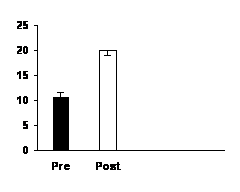
Figure 1. Demonstration of knowledge and understanding
of the elements of the RIP. There were
a total of 25 points available on this portion of the assessment.
*Mean post-assessment score
is significantly greater than mean pre-assessment score [F (1,10)
= 67.13, p<0.001].
The post-3-day workshop increase in teacher-participant
knowledge and understanding of the research process was accompanied by a
significant increase in teacher’ self-reported familiarity and understanding of
concepts related to the scientific research process in the concepts inventory
(Figure 2, below). By the end of the workshop, the average participant’
response rose from “familiarity with fair understanding of concept” to “very
familiar with concept and could teach it to others.” This showed that teachers recognized their
increased knowledge and understanding.
Mean (+SEM) RIP Concept Inventory Score
|
|
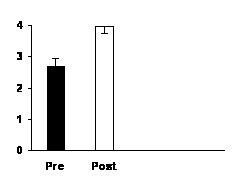
Figure 2. Familiarity and
understanding of concepts related to elements of the RIP. The answer scale for the concept inventory
items included “I am completely unfamiliar with this concept” (value=1), “I am
somewhat familiar with this concept, but do not really understand what it
means” (value = 2), “I am familiar with this concept, and have a fair
understanding of what it means” (value = 3), “I am very familiar with this
concept, but would have some difficulty teaching it to others” (value = 4), and
“I am completely familiar with this concept and could easily teach it to
others” (value = 5).
* Mean post-assessment score is significantly greater
than mean pre-assessment score [F (1,10) = 32.74, p<0.001].
By the end of the initial 3-day workshop,
participants’ self-reported confidence levels for
their ability to use scientific inquiry, their
understanding of teaching science through inquiry, and their ability to teach
and engage students in scientific research activities all significantly increased,
doubling compared to pre-workshop levels (Figures 3, 4, and 5, below).
Mean (+SEM) Confidence
Score
|
|
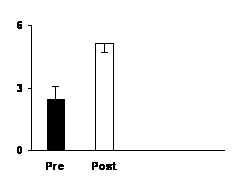
Figure 3. Self-reported
confidence levels for participants’ ability to use scientific inquiry. The response scale for the confidence items
included “not at all confident” (‘0’-value), “somewhat confident” (‘3’-value),
“confident” (‘6’-value), and “completely confident” (‘9’-value).
*Mean post-assessment score
is significantly greater than mean pre-assessment score [F (1,10)
= 17.16, p=0.002].
Mean (+SEM) Confidence
Score
|
|
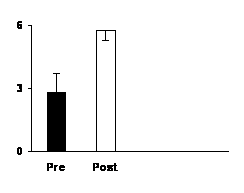
Figure 4. Self-reported
confidence levels for understanding of teaching science through inquiry. The response scale for the confidence items
included “not at all confident” (‘0’-value), “somewhat confident” (‘3’-value),
“confident” (‘6’-value), and “completely confident” (‘9’-value).
*Mean post-assessment score
is significantly greater than mean pre-assessment score [F (1,10)
= 15.75, p=0.003].
Mean (+SEM) Confidence
Score
|
|

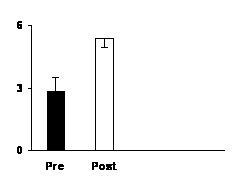
Figure 5. Self-reported
confidence levels for ability to teach and engage students in scientific
research activities. The response scale
for the confidence items included “not at all confident” (‘0’-value), “somewhat
confident” (‘3’-value), “confident” (‘6’-value), and “completely confident”
(‘9’-value).
*Mean post-assessment score
is significantly greater than mean pre-assessment score [F (1,10)
= 15.80, p=0.003].
Teacher Understanding of and Ability to Apply Data
Summary, Presentation, and Analysis techniques for Decision-Making in Science
By the end of the initial 3-day workshop, participants
demonstrated a dramatic, statistically significant increase in their knowledge
and ability to correctly organize data into a summary table and to construct a
bar graph for comparing the central tendency of two groups of data (Figure 6, below).
Mean (+SEM) Data Summary & Presentation Score
|
|
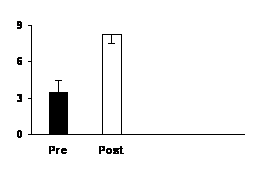
Figure 6.
Demonstration of understanding and ability to apply data organization
and presentation techniques to data.
This section was worth a total of 10 points.
* Mean post-assessment score
is significantly greater than mean pre-assessment score [F (1,10) = 18.47, p=0.002].
Workshop participants also demonstrated a very large change
in their knowledge and ability to apply data analysis techniques to research
data. Comparison of the pre-and
post-assessments revealed that by the end of the 3-day workshop, participants
significantly increased their understanding of how to calculate descriptive
statistics and their ability to determine which measure of central tendency is
most appropriate for a group of data (Figure 7, below).
Mean (+SEM) Data Analysis Score
|
|
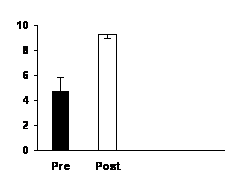
Figure 7.
Demonstration of understanding the calculations for descriptive
statistics and ability to determine the most appropriate statistic to represent
central tendency for a group of data.
This section was worth a total of 10 points.
* Mean post-assessment score
is significantly greater than mean pre-assessment score [F (1,10)
= 16.96, p=0.002].
Teacher-participants demonstrated a statistically
significant increase in their ability to interpret data presented in
scatterplots and summarized in bar graphs by the end of the 3-day workshop
(Figure 8, below).
Mean (+SEM) Graph Interpretation Score
|
|
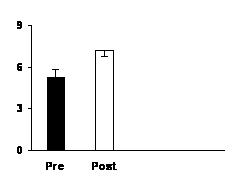
Figure 8.
Demonstration of ability to interpret scatterplots and bar graphs. This section was worth a total of 10 points.
* Mean post-assessment score
is significantly greater than mean pre-assessment score [F (1,10)
= 19.17, p=0.001].
The post-3-day workshop increases in teacher-participant
knowledge of and ability to apply data presentation and analyses were
accompanied by significant increases in teacher’ self-reported familiarity and
understanding of concepts related to data presentation and analysis (Figures 9
and 10, below). By the end of the
workshop, the average participant’ response for the three measures of central
tendency rose significantly from “somewhat familiar with concept, but do not
really understand what it means” to “very familiar with concept, but would have
some difficulty teaching it to others” (Figure 9).
Mean (+SEM) Central Tendency Concept Inventory
Score
|
|
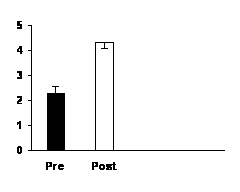
Figure 9. Familiarity and
understanding of concepts related to measuring central tendency. The answer scale for the concept inventory
items included “I am completely unfamiliar with this concept” (value=1), “I am
somewhat familiar with this concept, but do not really understand what it
means” (value = 2), “I am familiar with this concept, and have a fair
understanding of what it means” (value = 3), “I am very familiar with this
concept, but would have some difficulty teaching it to others” (value = 4), and
“I am completely familiar with this concept and could easily teach it to
others” (value = 5).
* Mean post-assessment score is significantly greater
than mean pre-assessment score [F (1,10) = 51.76, p<0.001].
Similarly, the average participant’ response for tables and
graphs rose significantly from “familiar with concept with a fair understanding
of what it means” to “very familiar with concept, but would have some difficulty
teaching it to others” (Figure 10).
Mean (+SEM) Tables & Graphs Concept Inventory
Score
|
|
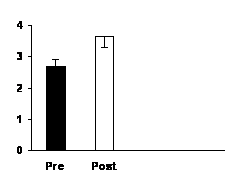
Figure 10. Familiarity and
understanding of concepts related to tables and graphs. The answer scale for the concept inventory items included “I am
completely unfamiliar with this concept” (value=1), “I am somewhat familiar
with this concept, but do not really understand what it means” (value = 2), “I
am familiar with this concept, and have a fair understanding of what it means”
(value = 3), “I am very familiar with this concept, but would have some
difficulty teaching it to others” (value = 4), and “I am completely familiar
with this concept and could easily teach it to others” (value = 5).
*Mean post-assessment score
is significantly greater than mean pre-assessment score [F (1,10)
= 21.20, p<0.001].
Benchmarks and Standards
General teacher
confidence and awareness of ability to understand and apply scientific inquiry
to the teaching of science and in ability to successfully address the
scientific inquiry standards were also affected by participation in the initial
3-day workshop. Teacher-participant
self-reported confidence in ability to address content standards in the
classroom rose significantly, from “somewhat confident” to “confident” by the
end of the workshop (Figure 11, below).
Mean (+SEM) Confidence
Score
|
|
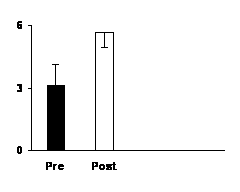
Figure 11. Self-reported
confidence levels for ability to address content standards in the
classroom. The response scale for the
confidence items included “not at all confident” (‘0’-value), “somewhat
confident” (‘3’-value), “confident” (‘6’-value), and “completely confident”
(‘9’-value).
* Mean
post-assessment score is significantly greater than mean pre-assessment score [F
(1,10) = 10.96, p=0.008].
Similarly, by the end of the workshop, participants’
confidence scores in their ability to accurately and completely address the
scientific inquiry benchmarks doubled, increasing from below “somewhat
confident” to near “confident” (Figure 12, below).
Mean (+SEM) Confidence
Score
|
|
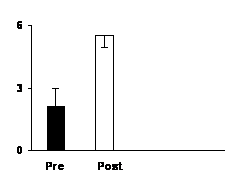
Figure 12. Self-reported
confidence levels for ability to accurately and completely address the
scientific inquiry benchmarks. The
response scale for the confidence items included “not at all confident”
(‘0’-value), “somewhat confident” (‘3’-value), “confident” (‘6’-value), and
“completely confident” (‘9’-value).
* Mean
post-assessment score is significantly greater than mean pre-assessment score [F
(1,10) = 18.51, p=0.002].
Finally, by the end of the 3-day initial workshop,
teachers significantly increased their familiarity and understanding of inquiry
standards from being “somewhat familiar with this concept, but not really
understanding what it means” to being “very familiar with this concept, but
would have some difficulty teaching it to others” (Figure 13, below). This increase was statistically significant
and was consistent with the increase in teacher-participant confidence
regarding addressing the scientific inquiry content standards and benchmarks
(Figures 11 and 12, above).
Mean (+SEM) Inquiry Standards Concept Inventory
Score
|
|
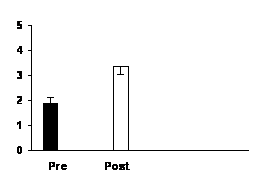
Figure 13. Familiarity and
understanding of the inquiry standards concept. The answer scale for the concept inventory items included “I am
completely unfamiliar with this concept” (value=1), “I am somewhat familiar
with this concept, but do not really understand what it means” (value = 2), “I
am familiar with this concept, and have a fair understanding of what it means”
(value = 3), “I am very familiar with this concept, but would have some
difficulty teaching it to others” (value = 4), and “I am completely familiar
with this concept and could easily teach it to others” (value = 5).
*Mean
post-assessment score is significantly greater than mean pre-assessment score [F
(1,10) = 15.80, p=0.003].
Teacher
Perceptions of Overall Impact of the Initial 3-Day Workshop on Understanding of
and Ability to Implement Standards-Based Inquiry
The Post-Workshop Questionnaire administered with
the Post-Assessment contained five self-report items designed to assess how
much teacher-participants believed their knowledge and abilities regarding the
scientific research investigation process (RIP) and scientific inquiry were
impacted by their participation in the initial 3-day workshop. The results from these items are presented in
Figures 14-19 below.
A majority of the workshop-participants (70%)
claimed that their understanding of the RIP was changed a “large amount” to “completely”
as a result of their participation in this workshop, while three participants
claimed it was changed a “moderate amount” (Figure 14, below).
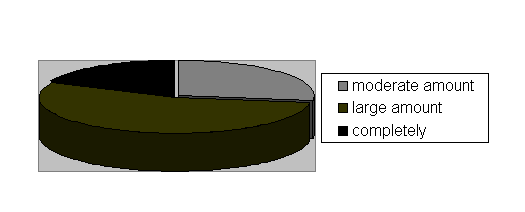
Figure
14. Pie chart representing 10
teacher-participants’ responses to “what extent, if any, did your understanding
of the research investigation process change as a result of your participation
in this workshop?” The scale for
responses included “none,” “a small
amount,” “ a moderate amount,” “a large
amount,” and “completely.” One
participant did not respond to this item on the Post-Workshop Questionnaire.
Four-fifths of the workshop-participants (8 of 10)
claimed that their understanding of the research investigation process improved
a “large amount” to “completely” as a result of their participation in the
3-day workshop (Figure 15, below). The
other two participants claimed “moderate” improvement in their understanding of
the RIP as a result of their participation.
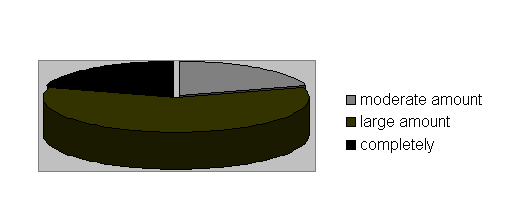
Figure
15. Pie chart representing 10
teacher-participants’ responses to “what extent, if any, did your understanding
of the research investigation process become clearer as a result of your
participation in this workshop?” The
scale for responses included “none,” “a
small amount,” “ a moderate amount,” “a
large amount,” and “completely.” One
participant did not respond to this item on the Post-Workshop Questionnaire.
Figure 16 presents a scatterplot of the
teacher-reported increase in understanding of the RIP plotted as a
function of change in understanding of the RIP, both as a result of
participation in the workshop.
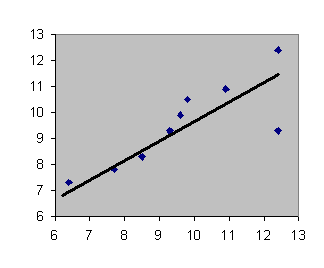
r(n=10) =.87, p< 0.002, r2=.76
|
|
|
|
Amount of
Increase in Understanding
|
|
|
|
|
|
|
|
Amount of Change in Understanding
|
|
|
Amount of
Increase in Understanding
|
|
|
Figure
16. Scatterplot of increase in
understanding as a function of change in understanding of the RIP, both
resulting from participation in the workshop.
One participant did not respond to both items and was eliminated from
the analysis.
There was a high positive, statistically
significant, relationship between the amount of change and the amount of
increase in understanding of the scientific research investigation process
(Figure 16): the greater the change in
understanding, the clearer the understanding became. Approximately 76% of the increase in
understanding was associated with the change in understanding.
All of the workshop-participants claimed that their
understanding of how to analyze research data was either “moderately” or “substantially”
increased as a result of their participation in this workshop (Figure 17,
below).
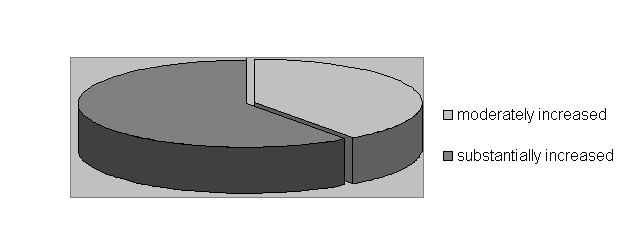
Figure
17. Pie chart representing 10
teacher-participants’ responses to completion of the statement, “as a result of my participation in this
workshop, my understanding of how to analyze research data has ______________.” The scale for responses included “remained
unchanged,” “slightly increased,” “moderately increased,” “substantially
increased,” “and “dramatically increased.”
One participant did not respond to this item.
Half of the participants “strongly” agreed that
their involvement in the initial three-day workshop increased their ability to
engage their students in standards-based science learning through scientific
inquiry, while the other half “moderately” or “slightly” agreed (Figure 18,
below).
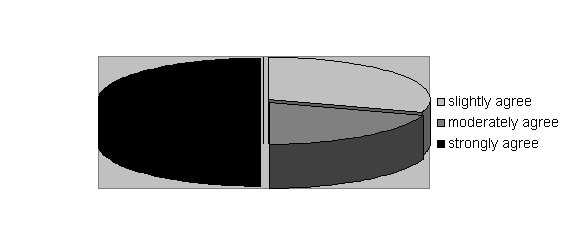
Figure
18. Pie chart representing
teacher-participants’ degree of agreement with
“My involvement in this workshop has increased my ability to engage my
students in standards-based science through scientific inquiry.” The scale for responses included “strongly
disagree,” “moderately disagree,” “slightly disagree,” “neutral,” “slightly
agree,” “moderately agree,” and “strongly agree.” One participant did not respond to this item.
A majority of the workshop-participants (6 of 10) “moderately”
to “strongly” agreed, while four “slightly” agreed, that involvement in the
initial three-day workshop increased their ability to develop a standards-based
unit incorporating the research investigation process (Figure 19, below).
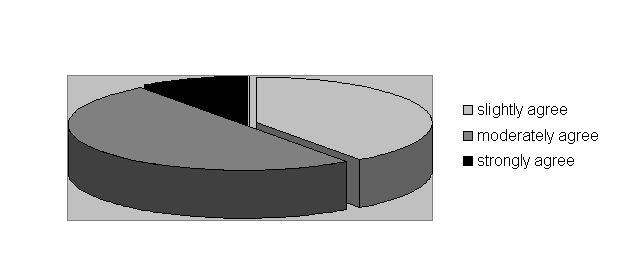
Figure
19. Pie chart representing
teacher-participants’ degree of agreement with
“My involvement in this workshop has increased my ability to develop a
standards-based unit incorporating the research investigation process.” The scale for responses included “strongly
disagree,” “moderately disagree,” “slightly disagree,” “neutral,” “slightly
agree,” “moderately agree,” and “strongly agree.” One participant did not respond to this item.
Impact
of Implementation and Follow-Up Activities
After the initial 3-day workshop, the teachers were
expected to begin to introduce and implement the RIP into their teaching
curriculum. There were two components of
follow-up in this professional development program: 1) the in-school/classroom
follow-up activities with the science literacy project director and individual
teachers or small groups of teachers and 2) the final one-day follow-up session
in which teachers had the opportunity to share the successes and challenges
that they and their students encountered during implementing of the RIP into
their classroom curricula. A
Post-Follow-Up Questionnaire, administered during the final one-day follow-up
session, was used to gather information related to the impact of the entire
workshop on teacher understanding of, and ability and confidence in using the
RIP as a tool to address science education standards, as well as for comparison
with pre- and post-assessment values from the initial three-day workshop
sessions and values from the Post-Workshop Questionnaire. Additional items were included on the
Post-Follow-Up Questionnaire to directly assess the impact of the
in-school/classroom follow-up activities on participant perceptions of
achievement of the workshop objectives.
Pre- versus
post-implementation and follow-up activities
Overall, although it is clear that substantial gains
in teacher knowledge about and ability to use and implement scientific inquiry
were achieved through the initial 3-day workshop, the implementation and
follow-up experiences led to considerable additional gains in the participants’
confidence and perceived ability to introduce the RIP to their students and successfully
address the science content standards.
Teacher-confidence in ability to use scientific
inquiry at the end of the program was significantly higher than before or after
the initial 3-day workshop (Figure 20, below).
Teachers were more than “confident” about their ability at the end of
the implementation and follow-up activities compared to slightly less than “confident”
after, and less than “somewhat confident” before the initial 3-day workshop. This suggests that the implementation of
inquiry-based science instruction in the classroom and the individual follow-up
activities positively impacted program-participants’ confidence.
|
|
|
|
|
|
|
|
Mean (+SEM) Confidence
Score
|
|
|
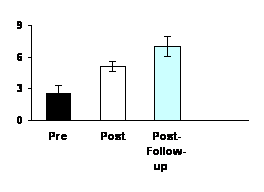
Figure 20. Teachers’
self-reported confidence in their ability to use scientific inquiry. The response scale for the confidence items
included “not at all confident” (‘0’-value), “somewhat confident” (‘3’-value),
“confident” (‘6’-value), and “completely confident” (‘9’-value). N=9, two participants did not respond to this
item.
One-way repeated
measures ANOVA: F(2,16) = 18.08, p<0.001
*Mean
post-workshop confidence significantly greater than mean pre-workshop confidence;
mean post-follow-up confidence significantly greater than mean pre-workshop
confidence; ** Mean post-follow-up confidence significantly greater than mean
post-workshop confidence
Program participants exhibited significantly higher
confidence in their ability to teach and engage their students in scientific
research activities following the implementation of the RIP into the classroom
and participation in individual follow-up compared with pre-3-day workshop
confidence levels (Figure 21, below). Although not statistically significant,
implementation of the RIP into the classroom and individual follow-up
activities resulted in a trend for increased self-reported confidence compared
with confidence levels following the initial 3-day workshop (Figure 21, below).
Mean (+SEM) Confidence
Score
|
|
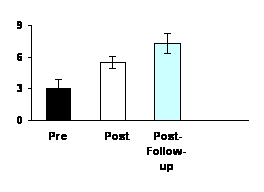
Figure 21. Teachers’
self-reported confidence in their ability to teach and engage their students in
scientific research activities.
One-way repeated
measures ANOVA: F(2,16) = 12.71, p<0.001
*Mean
post-workshop confidence significantly greater than mean pre-workshop
confidence; mean post-follow-up confidence significantly greater than mean
pre-workshop confidence.
Although
a statistically significant difference was not obtained, there was a trend for
a difference between the mean post-follow-up confidence and mean post-workshop
confidence levels.
Similarly, although
participants’ confidence in their understanding of teaching science through
inquiry following implementation and follow-up activities appeared to increase
above the post-3-day workshop confidence level, these confidence levels were
not statistically different (Figure 22, below).
Mean (+SEM) Confidence
Score
|
|
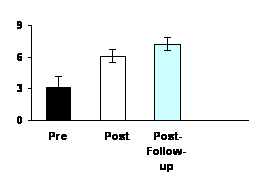
Figure 22. Teachers’
self-reported confidence in their understanding of teaching science through
inquiry. The response scale for the
confidence items included “not at all confident” (‘0’-value), “somewhat
confident” (‘3’-value), “confident” (‘6’-value), and “completely confident”
(‘9’-value).
One-way repeated
measures ANOVA: F(2,16) = 12.01, p<0.001
*Mean
post-workshop confidence significantly greater than mean pre-workshop
confidence; mean post-follow-up confidence significantly greater than mean
pre-workshop confidence.
The impact of both the implementation
of the RIP into the classroom and the individual participant follow-up
activities resulted in an increase in teacher confidence in ability to address
content standards in the classroom. By
the end of the classroom implementation and follow-up, confidence levels had
significantly increased from a pre-initial workshop level of “somewhat
confident” to above “confident” (Figure 23, below).
Mean (+SEM) Confidence
Score
|
|
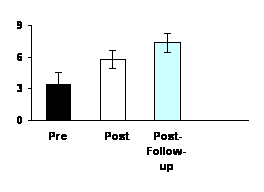
Figure 23. Teachers’
self-reported confidence in their ability to address content standards in their
classroom. The response scale for the
confidence items included “not at all confident” (‘0’-value), “somewhat
confident” (‘3’-value), “confident” (‘6’-value), and “completely confident”
(‘9’-value).
One-way repeated
measures ANOVA: F(2,16) = 8.34, p=0.003
*Mean
post-follow-up confidence significantly greater than mean pre-workshop
confidence.
After implementation of
the RIP into the classroom and individual follow-up, confidence of participants
in their ability to completely and accurately address the scientific inquiry
benchmarks appeared to be higher compared with confidence levels at the end of
the initial 3-day workshop (Figure 24, below).
Self-reported confidence levels were raised significantly from below “somewhat
confident” to “confident” after the 3-day workshop and to between “confident”
and “very confident” after the implementation and follow-up activities. Although not statistically different, there
was a trend for a difference between the Post-Workshop confidence and the
Post-Follow-Up confidence levels.
Mean (+SEM) Confidence
Score
|
|
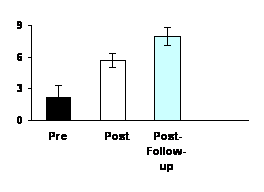
Figure 24. Teachers’
self-reported confidence in their ability to completely and accurately address
the scientific inquiry benchmarks. The
response scale for the confidence items included “not at all confident”
(‘0’-value), “somewhat confident” (‘3’-value), “confident” (‘6’-value), and
“completely confident” (‘9’-value).
One-way repeated
measures ANOVA: F(2,16) = 17.33, p<0.001
*Mean
post-workshop confidence significantly greater than mean pre-workshop
confidence; mean post-follow-up confidence significantly greater than mean
pre-workshop confidence.
Although
a statistically significant difference was not obtained, there was a trend for
a difference between the mean post-follow-up confidence and mean post-workshop
confidence levels.
There
was no difference in impact from implementation of the RIP into the classroom and
individual follow-up compared with that of the initial 3-Day workshop on
teachers’ self-reported increases in their understanding of how to analyze
research data (Figure 25, below). In
each case, program participants reported “substantial” increases in
understanding.
Mean (+SEM) Increase Score
|
|
Workshop Assessment Session
|
|
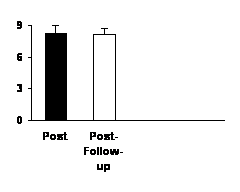
Figure 25. Teacher self-reported
increase in understanding of how to analyze research data after the initial
3-day workshop session (Post) compared to after participating in the entire
program. N=8, three subjects did not
respond to this item on the Post-Workshop and/or Post-Follow-Up Questionnaires.
* Mean
post-follow-up assessment value was not statistically different from the mean
post-3-day assessment value [F (1,7) = .13, p>0.05].
Compared to after the initial 3-day workshop, after
participation in the implementation and follow-up activities, program
participants reported a significantly greater positive impact on their ability
to engage their students in standards-based science learning through scientific
inquiry (Figure 26, below).
Workshop
Assessment Session
|
|
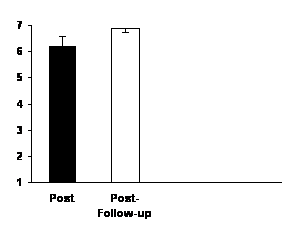
Figure 26. The extent to which
teachers agreed with the statement, “My involvement in this workshop has
increased my ability to engage my students in standards-based science learning
through scientific inquiry,” after the 3-day workshop session (Post) compared
to after the follow-up session. N=8,
three subjects did not respond to this item on the Post-Workshop and/or
Post-Follow-Up Questionnaires.
*Mean
post-follow-up assessment value was significantly greater than the
mean post-3-day assessment value [F(1,7)
= 5.65, p<0.05].
Teachers’ perceived ability to develop a standards-based
unit incorporating the research investigation process was significantly higher
after the implementation and follow-up activities compared to after the 3-day
initial workshop participation (Figure 27, below).
Workshop
Assessment Session
|
|
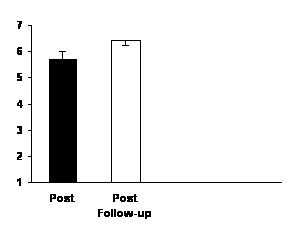
Figure 27. The extent to which
teachers agreed with the statement, “My involvement in this workshop has
increased my ability to develop a standards-based unit incorporating the
research investigation process,” after the 3-day workshop session (Post)
compared to after the follow-up session.
N=8, three subjects did not respond to this item on the Post-Workshop
and/or Post-Follow-Up Questionnaires.
*Mean Post-Follow-Up
Questionnaire value was significantly greater than the
mean Post-Workshop Questionnaire value [F(1,7)
= 18.02, p=0.004].
All of the participants who attended the final
follow-up session responded that their use of scientific inquiry in the
classroom had “increased” or “greatly increased” since participating in the science
literacy/inquiry program (Figure 28, below).
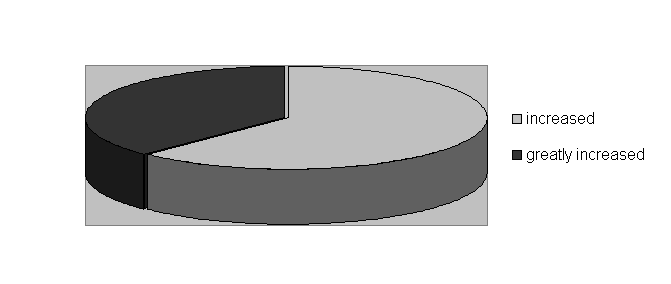
Figure
28. Pie chart representing
teacher-participant responses in completing the following sentence: “Since
participating in this inquiry workshop program, my use of scientific inquiry in
the classroom __________.” The scale for
responses included “greatly decreased,” “decreased,” “remained unchanged,”
“increased,” and “greatly increased.”
N=8, three subjects did not respond to this item on the Post-Follow-Up
Questionnaire.
Participants who attended the final follow-up
session responded that engaging their students in learning science through
inquiry “increased” or “greatly increased” their students’ interest in learning
science (Figure 29, below).
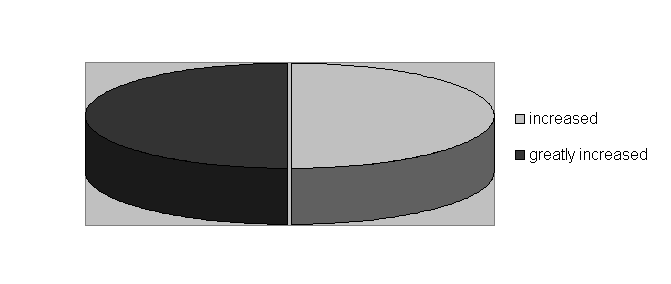
Figure
29. Pie chart representing
teacher-participant responses in completing the following sentence: “Engaging
my students in learning science through inquiry has __________ their interest in learning
science.” The scale for responses
included “greatly decreased,” “decreased,” “not changed,” “increased,” and “greatly
increased.” One of the eighteen
participants who attended the follow-up session did not respond to this
item. N=8, three subjects did not
respond to this item on the Post-Follow-Up Questionnaire.
Evaluation of in-school/classroom follow-up session impact
All seven of the program-participants who
participated in individual follow-up agreed that their follow-up experience
enhanced the quality of their classroom inquiry experiences with their
students, with five agreeing “a large amount” or “completely” and two “a
moderate amount” (Figure 30, below).
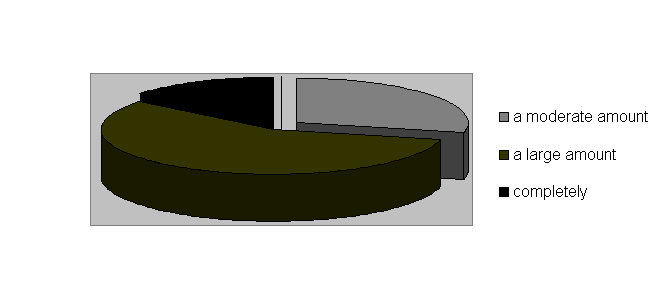
Figure 30. Pie chart representing teacher-participant
responses to the question, “To what
extent, if any, did the follow-up sessions enhance the quality of your
classroom inquiry experiences with you students?” The scale for responses included “none,” “a small amount,” “a moderate amount,” “a large amount,” and
“completely.”
Program participants felt that the individual
teacher follow-up was a valuable tool for enabling them to use the RIP in their
classroom instruction. All of the
workshop-participants who participated in individual follow-up stated that
their participation in the follow-up contributed moderately, “a large amount,”
or “completely” to their ability to implement the RIP with their students
(Figure 31, below).
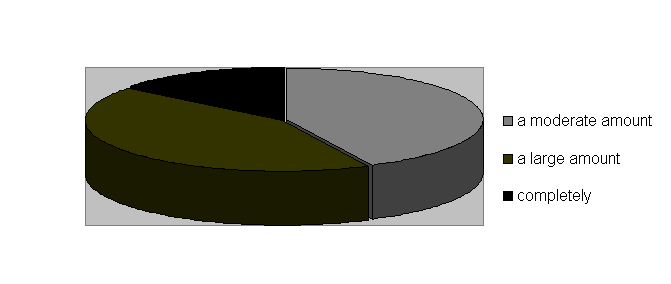
Figure 31. Pie chart representing teacher-participant
responses about the extent to which the follow-up sessions contributed to their
ability to implement the RIP with their students. The scale for responses included “none,” “a small amount,” “a moderate amount,” “a large amount,” and
“completely.” N=7, four subjects did not
respond to this item on the Post-Follow-Up Questionnaire.
One workshop participant reported complete
influence, five “a moderate” or “large” influence, and one a slight influence of
their participation in individual follow-up activities on changes in their
understanding of the research investigation (Figure 32, below).
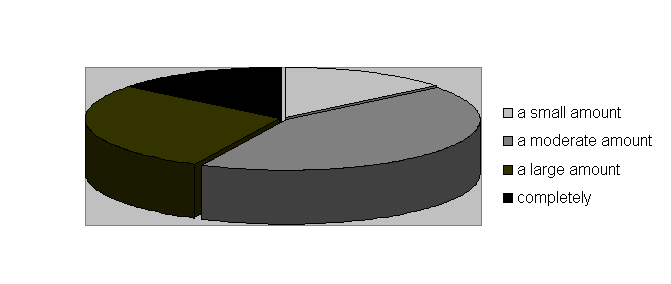
Figure 32. Pie chart representing teacher-participant
responses as to the extent to which the follow-up sessions changed their
understanding of a research investigation.
The scale for responses included “none,”
“a small amount,” “a moderate
amount,” “a large amount,” and “completely.”
N=7, four subjects did not respond to this item on the Post-Follow-Up
Questionnaire.
Almost 75% (4 of 7) of the teachers who took part in
individual follow-up activities responded that their participation led to a “large”
or complete increase in their understanding of the RIP (Figure 33, below).
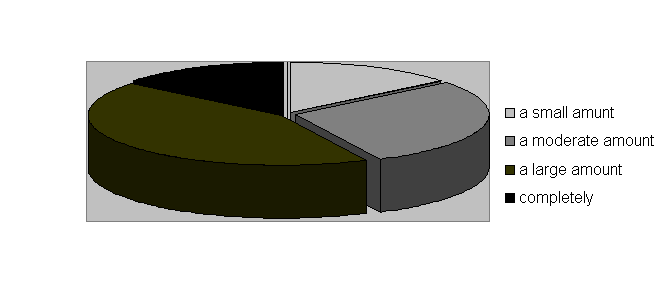
Figure 33. Pie chart representing teacher-participant
responses as to the extent to which the follow-up sessions increased the
clarity of their understanding of the RIP.
The scale for responses included “none,”
“a small amount,” “a moderate
amount,” “a large amount,” and
“completely.” One of the 16 teachers who
participated in the individual follow-up activities did not respond to this
item. N=7, four subjects did not respond
to this item on the Post-Follow-Up Questionnaire.
PD-Credit
Evaluation Items
The Hawaii State DOE Professional Development (PD)-Credit
Evaluation was administered to the 9 teachers who were taking this science
literacy/inquiry program for credits.
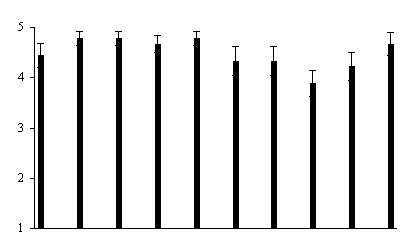
Figure 34 below presents then mean teacher responses for each of the ten
items on the PD Evaluation. All of the
ten PD-Credit items pertaining to this science literacy/inquiry program
exceeded the “more than meets” the standard criterion, with five of those
closely approaching “meets to a high degree.”
|
Degree
to
which Item
Meets
the
Standard
(Mean + SEM)
|
|
|
|
|
Figure 34. Honolulu District 2003 Science
Literacy-Scientific Inquiry Professional Development Workshop.
Items: 1) focuses on Hawaii Content and Performance
Standards, 2) focuses on student learning, 3) results-oriented, 4) appropriate
content, on-going and sustained, 5) active engagement, 6) collegial, 7) job-embedded,
8) systemic perspective, 9) client-focused and adaptive, and 10) incorporates
reflection
Program
Evaluation Summary
Based on the findings from this evaluation, Teaching Science Literacy through Inquiry-The
Research Investigation Process (RIP) successfully introduced K-6 teachers
to the teaching of science through true scientific inquiry, meeting or
exceeding the program’s goals in all aspects of professional development
assessed. The professional development
program successfully instructed teachers in using the research investigation
process (RIP) and afforded them the opportunity to explore the RIP as a tool
for addressing the Hawaii Science Content and Performance Domain I
standards. Teacher-participants learned
to use the inquiry process and to design and conduct scientific research
studies; became familiar with techniques
to assist in guiding students through the scientific inquiry process; demonstrated
understanding of, and competence in the ability to apply data analysis
techniques to decision-making in science; reported increased confidence in
using scientific research in their approach to instructing students in science
and in addressing the scientific inquiry benchmarks and science inquiry content
standards; successfully implemented the RIP as a tool for instruction in the
classroom; and reported increased student interest in the learning of science.
Although the
implementation into the classroom and follow-up activities appeared to have had
a strong impact on the success of this program, interpretation of these data should
be made with caution. To ensure that
measured effects from comparisons of measurements taken after the initial 3-day
workshop and again after implementation and follow-up activities were caused by
these activities and not the passage of time, control groups of teachers who
did not participate in either one or both of these post initial 3-day workshop
activities should be included. Inclusion
of these control groups within this scientific literacy/inquiry project was not
possible for both practical and ethical reasons.